
ChatGPT product discovery: how merchants can become easier to evaluate
By Nexscope Team · Published September 18, 2026 · Updated October 8, 2026
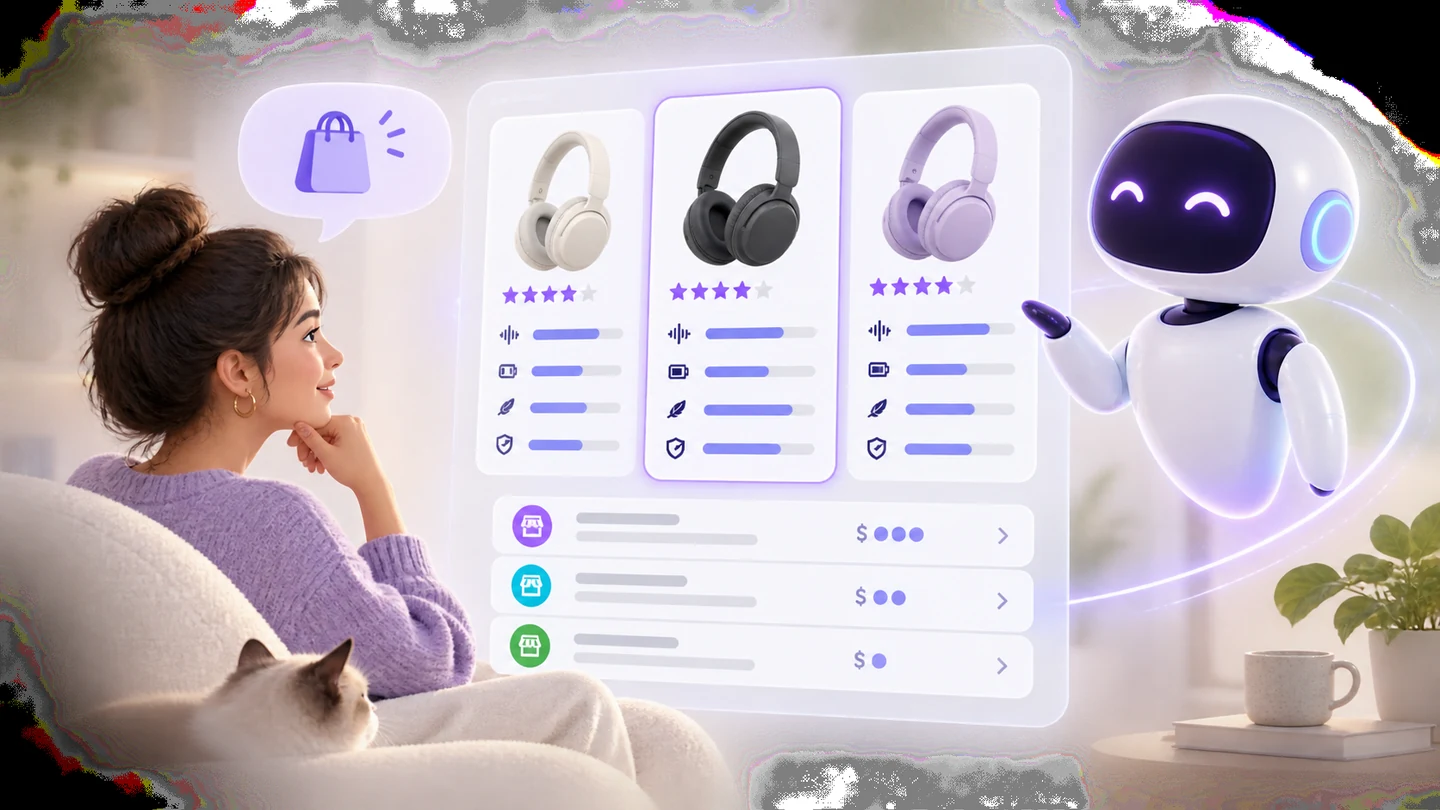
ChatGPT product discovery helps shoppers research and compare products through a conversation instead of relying only on a list of links. Merchants cannot guarantee a recommendation, but they can make products easier to evaluate by publishing accurate catalog data, explicit attributes, accessible pages, useful media, consistent offers, and evidence for important claims.
The practical takeaway: optimize for the shopper’s decision, not for a chatbot-shaped keyword. A product should clearly answer who it is for, which constraints it satisfies, what it costs, where it is available, and why its claims are credible.
How can a merchant get products into ChatGPT Shopping?
A public page can be discovered, but a merchant product feed is the direct catalog route. OpenAI says Shopify and Etsy catalogs are already integrated. Merchants on another platform can apply to share a product feed; OpenAI currently onboards approved partners rather than accepting every feed automatically. Check the current status of your own selling platform before building a second integration.
If OpenAI approves a direct feed, prepare one record per purchasable item or variant. Its current product specification requires a stable item ID, title, factual description, product URL, brand, seller name, image URL, availability and price. The URL should lead to the current selling page. Keep the full catalog and later price or stock changes synchronized using the delivery method agreed during onboarding. OpenAI’s integration guide describes file upload and API options; submitting a feed enables eligibility, not guaranteed placement. Shopping discovery does not require a separate checkout integration.
Nexscope currently does not send Gallery submissions to OpenAI. If a product is sold on Amazon or another marketplace, an ASIN or marketplace URL in a Nexscope submission is not authorization to manage that seller’s catalog or offer. The seller should use the marketplace’s supported path or apply through a channel it controls.
What changed in ChatGPT product discovery?
OpenAI described expanded product-discovery capabilities and commerce integrations in its March 24, 2026 announcement. The company has also published information about the Agentic Commerce Protocol and commerce policies. These systems and eligibility rules can change; use OpenAI’s product-discovery announcement as the authoritative starting point.
Nexscope is not affiliated with OpenAI and cannot control inclusion, ranking, citations, merchant eligibility, or checkout support.
What makes a product easy to compare?
A conversational shopper may express several constraints at once. Consider: “I need noise-cancelling headphones under $250 for long flights, with multipoint connection and replaceable ear pads.” A useful product record needs more than a broad title.
| Shopper question | Evidence to publish | Ambiguous version |
|---|---|---|
| Is it under budget? | Current variant-level price and currency | “Starting at” without mapping |
| Will it work for travel? | Weight, battery test conditions, case dimensions | “Travel ready” |
| Does it support my devices? | Bluetooth version and explicit multipoint support | “Universal compatibility” |
| Can I maintain it? | Replaceable parts and supported part numbers | “Built to last” |
| Can I return it? | Clear market-specific return policy | Policy hidden at checkout |
Unknown values should remain unknown until they are verified. Filling a data gap with invented certainty creates a customer and compliance risk.
How should merchants prepare?
Keep catalog and page data aligned
Use stable IDs, variant-level prices, current availability, correct URLs, descriptive attributes, and accurate media. The landing page and merchant data should not disagree about a color, capacity, price, or shipping promise.
Write for constrained questions
Use buyer language naturally in headings, comparison tables, specifications, FAQs, and support content. Do not repeat a phrase simply because it appears in a keyword tool. Help a shopper resolve an actual constraint.
The Nexscope SEO Keyword Planner can help organize search language by use case, attribute, concern, and comparison.
Make claims auditable
Define what “waterproof,” “fast,” “safe,” “sustainable,” or “all-day” means. Include a test standard, condition, certification, material, or limitation when relevant. Reviews can reveal where shoppers interpret a claim differently, but a review sample does not prove a population-wide defect.
Publish accurate, useful media
Show scale, ports, materials, setup, fit, or a product in use. AI-generated product images and video should be checked against the real SKU. Do not depict features the product does not have.
For a source-backed still-image review process, see the ChatGPT Images 2.5 ecommerce product-photo guide. It is an editing workflow, not a claim that Nexscope provides OpenAI’s image model.
Keep the page retrievable
Use semantic HTML, useful internal links, correct canonicals, crawlable product content, and structured data that matches visible information. The Website SEO Auditor can help identify page-level issues; it does not guarantee ChatGPT inclusion.
Where does Nexscope Product Gallery fit in AI shopping preparation?
The Nexscope Product Gallery gives approved submissions an additional public product page; it is not a merchant feed or a direct ChatGPT integration. The page brings submitted details, images, optional video and a link to the original listing together after editorial review. The merchant’s own listing remains the source for current price, stock, variants, delivery and purchase terms.
If you submit a product, use its exact model or variant and answer the questions a buyer would ask before deciding. For example, a travel mug submission could state its measured capacity, dimensions, lid type, compatible cup holders, cleaning instructions and any limits on a leak-resistance claim. Include the source or test condition for important claims; leave unknown facts unknown. These details can help a person evaluate the product and give an AI-assisted researcher clearer public context, but no page can force an AI system to retrieve or recommend it.
Use this workflow to keep the channels separate:
- Maintain the original store or marketplace listing. Check that product identity, attributes, images, price and availability are current there. A Gallery page does not replace a merchant catalog, Merchant Center feed or participating platform’s commerce requirements.
- Submit a useful public description. Explain who the product fits, the exact specifications that matter, limits and evidence. The Gallery team reviews the submission before any public display; publication is not automatic.
- Check the approved page and source link. Make sure the public description still matches the live product. Use the private management link to edit and resubmit or take the Gallery page offline if information changes.
- Measure AI answers separately. The Nexscope AI Product Visibility Tool can test one product against sampled shopping questions and show mentions, recommended position, citations and competing products. Record the market, prompts, model and run date. A report is a time-bound observation, not evidence that Gallery publication caused a change.
Google distinguishes product pages that allow direct purchase from pages that refer shoppers to another seller. Follow Google’s product structured-data guidance on the merchant’s own site; a Gallery page is an additional information source, not a shortcut to merchant-listing eligibility.
A product-discovery audit with Nexscope
- Write five constrained buyer questions for one high-value SKU.
- Research related search language and comparable marketplace products.
- Sample customer reviews and preserve the original evidence.
- Build an attribute-and-claim matrix for the product page.
- Audit the page’s indexability, structure, content, and canonical URL.
- Test the same prompts across supported assistants and search surfaces.
- Record dates, markets, sources, answers, citations, and destination pages.
Use the Nexscope API documentation to confirm current product, keyword, review, search, and AI-visibility capabilities before building an automated workflow.
How is product discovery different from ChatGPT Ads?
Product discovery describes the wider shopping and research experience. Advertising is paid distribution within supported experiences. A merchant may appear in one, both, or neither, depending on current systems, eligibility, relevance, and campaign settings.
Measure the channels separately. Read the ChatGPT Ads ecommerce readiness guide before combining paid traffic with organic or product-discovery reporting.
What should you measure?
- product and category landing-page sessions;
- engaged sessions and meaningful scroll;
- comparison, pricing, or specification interactions;
- add-to-cart, checkout start, lead, or purchase events;
- sampled mentions and citations for a fixed query set;
- feed and page consistency errors;
- assisted conversions, with attribution limitations documented.
AI referrals can lose or change referrer details. Add UTM parameters to links you control and use the GA4 AI referral traffic guide for source analysis.
Start with one product, not a promise of AI ranking
Choose one product and one constrained buyer question. Check the original listing’s facts and buying terms, then submit the product to the Nexscope Gallery if you want an additional reviewed public page and editorial suggestions. Run an AI visibility report separately to observe sampled shopping answers. Neither step replaces the merchant’s own catalog or guarantees that an AI assistant recommends the product.
For a narrower check of what shoppers see after discovery, use the product-card versus offer-card seller audit. It separates the product choice from the merchant offer and explains the limits of a recent observational shopping study.
Sources
- OpenAI: Powering Product Discovery in ChatGPT, March 24, 2026
- OpenAI: Merchant application and supported catalogs
- OpenAI: Product feed integration guide
- OpenAI: Product feed specification
- OpenAI: Reimagining advertising with AI, September 16, 2026
- Google Search Central: Product structured data
- Google Search Central: Merchant listing structured data
Last reviewed: 2026-10-08 · Maintained by the official Nexscope team · Editorial & evidence policy.
More on seo & ai visibility
Bring a real ecommerce question.
Ask how to use a Nexscope workflow, suggest an improvement, or report a reproducible problem through the right public channel.